Wildlife conservation volunteering abroad is defined as structured, field-based participation in ecological protection programs outside your home country, where volunteers contribute directly to species monitoring, habitat restoration, and data collection alongside professional conservation staff. This is formally known as conservation voluntourism within the academic and NGO community, though the field experience itself is anything but academic. Programs span continents, from sea turtle nesting beaches in Costa Rica to big cat monitoring reserves in Botswana and Tanzania. The work is physical, unpredictable, and genuinely consequential. If you are a nature-driven traveler looking to do more than observe, this guide covers everything you need to know before committing.
What does wildlife conservation volunteering abroad actually require?
The honest answer is that most programs require less formal qualification than you might expect, but more physical and psychological readiness than most people anticipate. Entry-level international projects prioritize motivation and physical capability over academic qualifications, which means a biology degree is not your ticket in. Genuine enthusiasm, outdoor adaptability, and a willingness to follow instructions from local conservation staff are what programs actually screen for.
Before you apply, work through this checklist:
- Minimum stay: Most field-based projects require a minimum commitment of 7 days, with remote programs in Botswana and Tanzania often expecting two to four weeks for meaningful contribution.
- Physical fitness: Expect long walks on uneven terrain, manual habitat restoration work, and night patrols. Cardiovascular fitness and the ability to carry gear in heat or humidity are non-negotiable.
- Vaccinations and documents: Yellow fever, typhoid, hepatitis A and B, and malaria prophylaxis are standard requirements for African programs. Costa Rica and Cape Verde have their own protocols. Check with a travel medicine clinic at least six weeks before departure.
- Ethical mindset: You are a guest in someone else’s ecosystem. Programs in South Africa and Tanzania are explicit about this. Respecting local staff authority and cultural norms is as important as any field skill.
- Motivation over experience: Conservation managers consistently report that the volunteers who contribute most are those who arrive curious and humble, not those who arrive with a fixed idea of what they will accomplish.
Pro Tip: Research whether your target program is affiliated with the IUCN Red List framework or a recognized conservation body. Affiliation signals scientific rigor and long-term ecological commitment rather than short-term tourism packaging.
Selecting community-led, sustainable projects from the start filters out the programs that use wildlife as a backdrop for volunteer tourism rather than genuine conservation. We will cover how to make that distinction in detail below.
What tasks do wildlife conservation volunteers actually do in the field?
The range of activities across international wildlife volunteering programs is broader than most travelers realize, and the work varies significantly by season, species, and location. Here is a realistic picture of what your days and nights might look like.
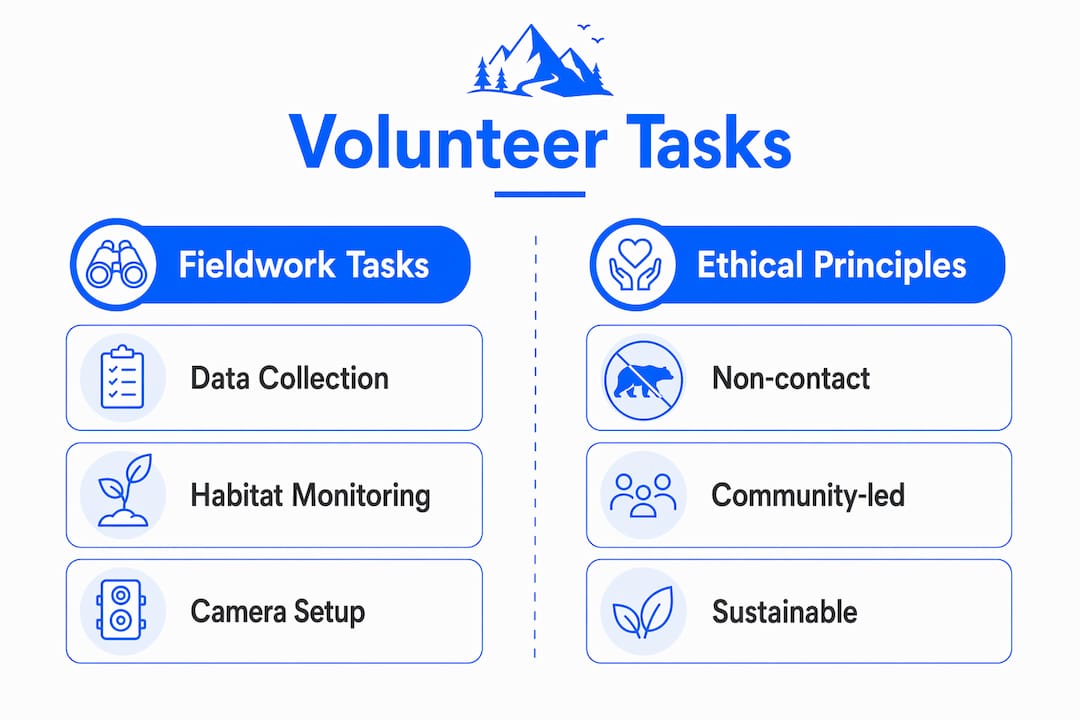
- Night beach patrols: On sea turtle conservation programs like the Osa Sea Turtle Volunteer Programme in Costa Rica, volunteers conduct nocturnal patrols to locate nesting females, record GPS coordinates, measure carapace dimensions, and protect clutches from poachers and predators. A single patrol can run four to six hours.
- Camera trap deployment and data retrieval: African wildlife monitoring programs in South Africa and Tanzania use camera trapping as a primary population assessment tool. Volunteers hike transects, swap memory cards, and log sighting data that feeds into species management databases.
- Habitat restoration: Invasive plant removal, reforestation planting, and erosion control are physically demanding but ecologically critical. Programs in Botswana and Cape Verde integrate this work into weekly schedules alongside species monitoring.
- Ranger support and data entry: Volunteers provide logistical support like data collection and monitoring, which enables core staff to focus on veterinary and management decisions. You are the field capacity that makes expert work possible.
- Hatchling releases and nest excavation: After incubation periods end, sea turtle nests are excavated to count hatched and unhatched eggs. This data tracks reproductive success across seasons and informs conservation strategy.
“The most meaningful thing I witnessed on a conservation project was not a dramatic wildlife encounter. It was watching a local ranger use three weeks of volunteer-collected camera trap data to make a real management decision about a leopard corridor. That data existed because volunteers showed up every morning and did the unglamorous work.”
Seasonal variation matters here. Sea turtle programs in Costa Rica peak between July and December. African wildlife monitoring is often most productive during dry seasons when animals concentrate around water sources. Scheduling your trip around biological cycles rather than travel convenience produces a richer and more impactful experience. Costa Rica’s conservation success offers a deeper look at how seasonal timing shapes volunteer outcomes in that region specifically.
One principle governs all of these activities: ethical wildlife volunteering involves zero direct social interaction with animals to avoid habituation. Even well-intentioned contact can compromise rehabilitation efforts and reduce an animal’s chances of surviving in the wild. The best programs enforce this strictly, and you should treat any program that does not as a red flag.
How to choose the right conservation volunteer program abroad
Choosing between programs is where most travelers make their biggest mistakes. The conservation voluntourism market includes genuinely impactful grassroots initiatives and commercially packaged experiences that deliver little ecological value. Knowing how to tell them apart protects both your investment and the wildlife you intend to help.
| Factor | Grassroots/Community-led programs | Commercial/Tourism-oriented programs |
|---|---|---|
| Management structure | Local conservation staff lead all decisions | External operators manage logistics and wildlife access |
| Volunteer role | Field data collection, monitoring, restoration | Curated wildlife encounters with minimal data contribution |
| Long-term impact | Feeds into multi-year ecological research | Ends when the volunteer group departs |
| Fee transparency | Fees fund local salaries and field equipment | Significant portion funds operator profit margins |
| Animal interaction policy | Strict non-contact protocols enforced | Photo opportunities with animals often included |
The most impactful projects are community-led grassroots initiatives that ensure volunteer presence supports long-term conservation rather than short-term tourism. This distinction is the single most important filter you can apply when comparing programs.
Beyond the grassroots versus commercial question, consider these practical factors. Remoteness and amenities vary enormously. Programs in Botswana and Tanzania often operate in areas with no consistent electricity or internet connectivity, which is genuinely challenging for volunteers expecting standard travel comforts. Programs in Costa Rica and South Africa tend to offer more infrastructure while still delivering meaningful field work.
Program length also shapes impact. A one-week placement in Tanzania gives you orientation and basic field tasks. A four-week placement lets you contribute to a complete data collection cycle and build real working relationships with local staff. If your schedule allows, longer is almost always better for the ecosystem and for you.
Pro Tip: Before paying any program fee, ask for a published breakdown of how funds are allocated. Legitimate programs are transparent about what percentage goes to local staff salaries, field equipment, and community development. Vague answers are a reliable warning sign.
Verify credibility by checking whether the program publishes research outputs, partners with recognized conservation organizations, or appears in peer-reviewed literature. Programs affiliated with organizations like the Wildlife Conservation Society or regional national park authorities carry a level of accountability that independent operators often do not.
What challenges should you expect, and how do you maximize your impact?
Realistic preparation for the difficulties of overseas conservation volunteering is what separates volunteers who thrive from those who burn out after a week. The challenges are real, but they are manageable with the right mindset.
- Off-grid living conditions: Remote programs in Botswana and Tanzania regularly operate without reliable electricity, running water, or internet access. Pack a headlamp, a water purification system, and the psychological readiness to disconnect from digital life for weeks at a time.
- Unpredictable schedules: Volunteer schedules require 24/7 flexibility because biological cycles dictate conservation work timing. Night patrols, dawn bird surveys, and midday habitat work do not conform to a nine-to-five structure. Fatigue management is a genuine skill in this context.
- Avoiding habituation: The temptation to interact with wildlife is powerful, especially with young or injured animals. Resisting it is one of the most important contributions you can make. Human contact, even gentle and well-meaning, can prevent successful wild release by teaching animals to associate humans with safety or food.
- Patience for long-term outcomes: Volunteer contributions are part of ongoing, incremental processes. You will not see a species recover during your placement. You will collect one season’s data in a decade-long study. Understanding this framing transforms frustration into purpose.
- Cultural respect: Conservation programs in Tanzania, Botswana, and Costa Rica operate within specific cultural contexts. Local staff have knowledge and authority that no amount of travel experience replaces. Following their lead, asking questions rather than making assumptions, and learning basic phrases in the local language all signal the respect that makes collaboration productive.
- Supporting logistics over administration: The highest-value contribution most volunteers make is in the field, not behind a desk. Volunteer impact is greatest when supporting logistical and monitoring tasks that free local experts to manage complex conservation decisions. Embrace the unglamorous work.
Key takeaways
Wildlife conservation volunteering abroad delivers genuine ecological impact when volunteers choose community-led programs, arrive physically prepared, follow strict non-contact protocols, and understand their role as one part of a long-term conservation effort.
| Point | Details |
|---|---|
| Program selection matters most | Choose community-led, grassroots programs over commercial operators to maximize real ecological impact. |
| Physical and ethical readiness | Arrive fit for outdoor manual labor and committed to non-contact wildlife protocols from day one. |
| Flexible scheduling is mandatory | Biological cycles drive work timing, including night patrols and dawn surveys, not human preferences. |
| Logistical support is your primary value | Data collection and monitoring free local experts to make complex conservation management decisions. |
| Long-term perspective sustains motivation | Your contribution feeds into multi-year ecological research, not a single-season transformation. |
Why humility is the most underrated conservation skill
I have spoken with volunteers who arrived at African reserves expecting to rescue animals and left frustrated because their days were spent entering GPS coordinates into spreadsheets. I have also spoken with volunteers who arrived expecting nothing beyond the chance to be useful and left having contributed to population data that shaped a reserve’s predator management plan for the following three years. The difference between those two experiences was not the program. It was the mindset.
What I have come to believe, after years of following conservation projects across Botswana, Tanzania, and Central America, is that the travelers who make the most meaningful contributions are those who treat local conservation staff as the experts they are. The rangers who have spent fifteen years tracking wildlife in the Okavango Delta know things that no orientation manual captures. The biologists managing sea turtle nesting sites in Costa Rica have context that a two-week volunteer simply cannot replicate. Your job is to amplify their capacity, not to direct it.
There is also something worth saying about the personal transformation side of this. The remarkable ecological adaptations you witness in the field, whether a leatherback turtle navigating by magnetic fields or a leopard moving through camera trap corridors at 2 a.m., will stay with you far longer than any curated safari moment. That is the reward for doing the real work. It is not immediate, and it is not photogenic. But it is genuine.
— Ben
Plan your wildlife conservation journey with Bendoestheworld
If this guide has sparked the urge to start planning, Bendoestheworld has the resources to move you from inspiration to itinerary. Our guide to top wildlife destinations in North America covers prime ecosystems where conservation volunteering intersects with extraordinary wildlife encounters, from the boreal forests of Canada to the wetlands of the Florida Everglades. For travelers drawn to Central America, our deep-dive into Costa Rica’s conservation programs covers the logistics, seasonal timing, and field realities of one of the world’s most celebrated ecological volunteering destinations. Use these guides alongside your program research to build a trip that is both personally rewarding and ecologically responsible.
FAQ
What is wildlife conservation volunteering abroad?
Wildlife conservation volunteering abroad is structured field participation in ecological protection programs outside your home country, including species monitoring, habitat restoration, and data collection. It is formally categorized as conservation voluntourism within the NGO and academic community.
Do I need prior experience to volunteer for wildlife conservation?
No prior experience is required for most entry-level programs. Projects in Tanzania, Botswana, and Costa Rica prioritize physical fitness, adaptability, and ethical conduct over academic or professional qualifications.
How long do wildlife conservation volunteer placements typically last?
Most field-based programs require a minimum stay of 7 days, with remote programs in Africa commonly expecting two to four weeks for volunteers to contribute meaningfully to ongoing research cycles.
How do I identify an ethical wildlife volunteer program?
Look for community-led programs with transparent fee structures, strict non-contact animal protocols, and published research outputs. Affiliation with recognized conservation bodies like the Wildlife Conservation Society or national park authorities adds accountability.
What are the biggest challenges in overseas conservation volunteering?
Off-grid living without electricity or internet, unpredictable work schedules tied to animal biology, and the discipline to avoid wildlife contact are the most commonly reported challenges. Patience with long-term, incremental ecological outcomes is equally important.